A viral thread on X claims Claude AI can help fix your entire money situation in a single weekend, and it has already drawn over 1 million views. The post, shared by creator CooperBaggs, breaks down 10 specific prompts covering everything from income diversification to debt payoff to mindset shifts — designed to be copied straight into Claude with your own numbers filled in.

What makes this approach interesting is the framing: instead of asking Claude vague questions like “how do I save money,” each prompt is built with specific structure, data points, and requested output formats — which is exactly the kind of prompt engineering that produces more useful financial guidance from AI. Below is the full list, organized by financial goal.cnbc
Building and Diversifying Income
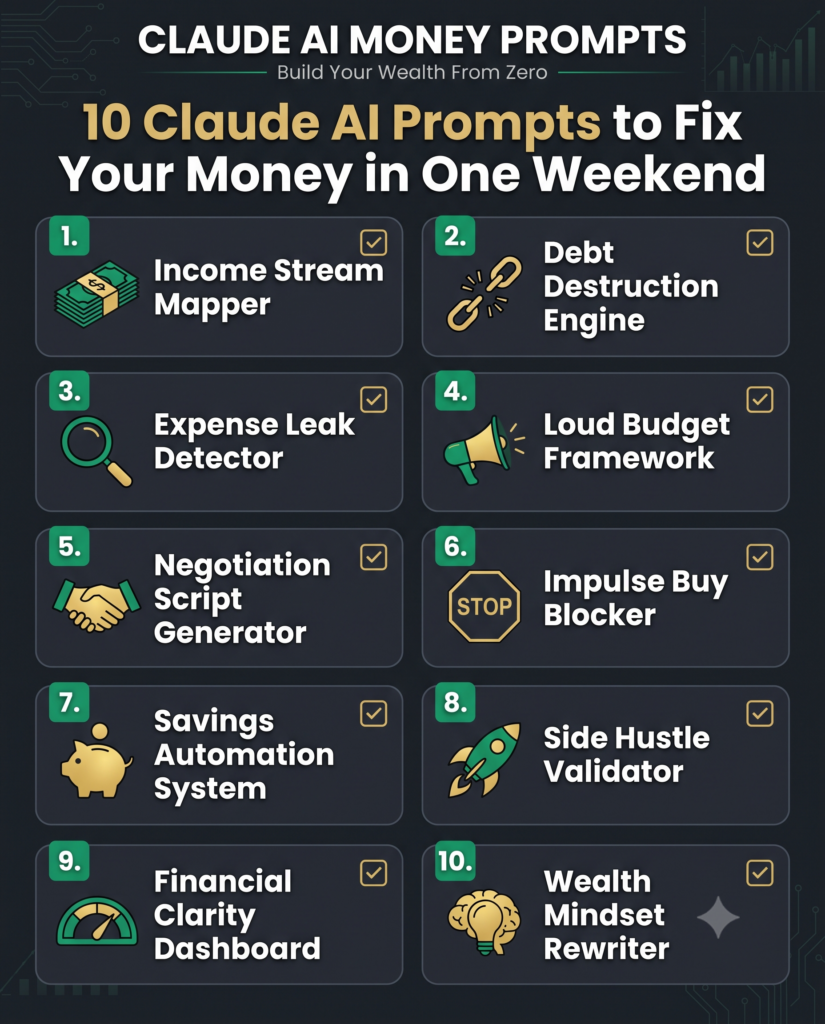
The first prompt asks Claude to map out seven income streams based on patterns seen in high-net-worth individuals — salary, investments, rental property, side business, dividends, royalties, and capital gains — complete with a 12-month build sequence and a resilience checklist to reduce dependency on a single income source.
Paying Off Debt Faster
The Debt Destruction Engine prompt has Claude compare three payoff strategies side by side: the snowball method (smallest balance first), the avalanche method (highest interest rate first), and a hybrid approach, including a tracker showing potential interest savings over three years.
This prompt turns Claude into a spending auditor, hunting for common leaks like forgotten subscriptions, water waste, food waste, and overpaid bills — categories where the average household can realistically cut 11 to 12 percent off recurring costs.
Removing Money Shame and Building Accountability
The “Loud Budget” prompt builds a transparency-based system for talking about money openly, including ready-made scripts for declining social invitations while stating financial goals out loud, paired with the standard 50/30/20 budgeting framework.
Negotiating a Higher Salary
This prompt generates a three-scenario negotiation script pulling market rate data, counter-offer numbers, and responses to common objections like “the budget is fixed,” including a practice routine ahead of the actual conversation.
Stopping Impulse Spending
The Impulse Buy Blocker prompt applies the 30-day rule (delaying non-essential purchases by a month) alongside a subscription audit method known as the 70/30 rule, where 70 percent of subscriptions should genuinely improve daily life.
Automating Savings
This prompt builds a savings hierarchy starting with a $1,000 emergency fund — a milestone 4 in 10 Americans reportedly can’t cover — before scaling to 3-6 months of expenses in a high-yield savings account, with automatic paycheck allocation rules.
Validating a Side Hustle Idea
The Side Hustle Validator prompt scores potential side hustle ideas on time-to-money, startup cost, weekly hour commitment, and market demand, producing a 30-day launch checklist for the top-ranked option.
Creating a Financial Dashboard
This prompt has Claude design a unified view linking checking, credit cards, mortgage, retirement, and crypto accounts into one dashboard concept, with color-coded spending categories and a 15-minute weekly review habit.
Rewiring Your Money Mindset
The final prompt shifts focus from goals to systems, using daily habit loops around savings rate, skill-building, and spending awareness, delivered as a 21-day mindset reset with journal prompts.
Why This Thread Resonated
Personal finance content paired with AI tools consistently performs well because it solves two anxieties at once: not knowing what to do with money, and not knowing how to use AI effectively. Every prompt in this list follows the same underlying formula: it gives Claude a role, specific data placeholders, and a requested output format — the same structure recommended by financial planning experts experimenting with AI-generated advice. That structure is worth copying even beyond these 10 examples.cnbc
Frequently Asked Questions
Is it safe to give Claude my real financial information?
It’s generally safer to use rounded numbers or ranges rather than exact account numbers, balances, or personal identifiers when using AI prompts for financial planning.
Can Claude actually replace a financial advisor?
No. These prompts are useful for organizing ideas, running scenarios, and getting a starting framework, but they don’t account for the full complexity of tax law, investment risk, or individual financial regulations a licensed advisor would consider.
Which prompt should I start with?
Most people benefit most from starting with the Expense Leak Detector or Savings Automation System, since these produce immediate, actionable numbers before moving into longer-term strategies like income diversification.