The internet was built for people. Mobile was built for people. According to a viral thread from entrepreneur Greg Isenberg that racked up nearly 300,000 views on X, the next major wave of startups will be built for machines instead — specifically, for AI agents.

Isenberg’s post lists 21 concrete startup opportunities emerging as AI agents become autonomous actors that need their own infrastructure, payment rails, and trust systems. The timing lines up with broader market data: the AI agent sector is projected to grow from roughly $7.84 billion in 2025 to $52.62 billion by 2030, a jump of over 500% in five years.
Below is a breakdown of the ideas, grouped into five practical categories for anyone thinking about building in this space.

Infrastructure and Tooling for Agents
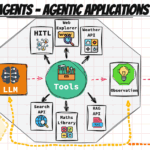
Agents don’t operate in a vacuum — they live inside “harnesses” like Hermes, and whichever tool becomes the default choice inside that environment tends to win big, similar to what happened in the desktop and mobile eras. Agents also need memory they can trust, meaning whoever becomes the shared brain an agent reads and writes to effectively becomes core infrastructure. On top of that, prompt and skill versioning is emerging as its own category — when an agent’s behavior degrades overnight, teams need a way to roll back to the exact instruction that broke it, essentially “git for agent behavior.”
The Financial Layer for Machines
Agents burn money differently than humans do — a single bad loop can spend $100 in tokens within eight minutes, which is why spend controls built specifically for agents (think “Ramp for agents”) are becoming essential. Related to this is the need for throwaway virtual cards that spin up and die per task, so an agent never has direct access to a real card or Stripe account; instead, it operates inside a sandbox. Escrow is also shifting toward machine verification, where funds only release once a job is confirmed done, no human required. Longer term, agents are expected to subscribe to other specialist agents on a recurring basis, creating a new layer of machine-to-machine recurring revenue.
Trust and Verification Between Agents
As agents start transacting with each other, new trust problems appear. Agents can get scammed by other agents, so a checkable track record before any transaction becomes real, valuable infrastructure. There’s also a growing need for a permission layer that proves an agent is acting on behalf of a real person with actual authority to spend. When agents fail — and they do, often silently and strangely — a “why did my agent do that” replay tool becomes critical for debugging. And when something goes wrong between two agents, disputes need a resolution system: essentially a court built for machines.
Marketplaces and Machine Labor
This is where the agent economy starts touching the physical world. Agents are expected to begin hiring robots directly — a software agent posts a real-world job, and a humanoid robot picks it up, creating a genuine marketplace for machine labor (think Fiverr, but the applicants are machines). Robots will also need to prove they completed physical tasks correctly, through photos, sensor data, or other verification, adding an entirely new layer to how physical work gets validated. Reliability itself becomes a product too: while a human just shrugs at a rate limit, an agent’s entire workflow can collapse, making high-throughput, dependable access its own sellable service.
Legal and Liability for Agent Actions
When an agent commits to something on a person’s behalf, someone is legally on the hook. Isenberg flags this as a probable venture-funded category: a legal and insurance layer specifically for actions taken autonomously by AI agents, covering liability that current frameworks weren’t built to handle.
Why This Matters Right Now
What makes this thread worth paying attention to isn’t just the volume of ideas — it’s that almost none of these categories currently have a clear market leader. Compare that to the current landscape of AI agent startups, where most attention is still concentrated on customer support, sales, and marketing agents. The infrastructure layer Isenberg describes — memory, spend controls, escrow, verification, and legal liability — is still wide open, which is usually the best time to build.
Frequently Asked Questions
What is the AI agent economy?
It refers to the emerging market of tools, infrastructure, and services built specifically for autonomous AI agents to operate, transact, and interact with each other, rather than for direct human use.
How do AI agents make money or spend money?
Agents typically operate through API tokens and automated workflows. As they gain more autonomy, they’re expected to use dedicated financial tools like virtual cards, escrow systems, and subscriptions to transact with other agents or services.
Is building for AI agents a real opportunity in 2026?
Market projections suggest significant growth in agent infrastructure spending through 2030, and most of the categories described — like agent memory, sandboxed environments, and machine-to-machine trust systems — remain largely unbuilt.