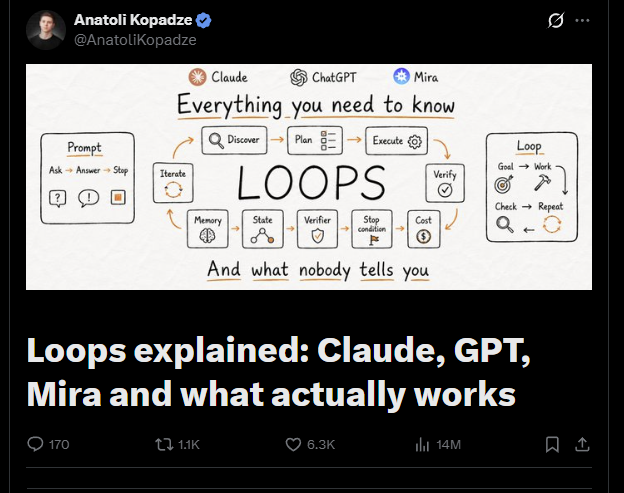
TL;DR (Executive Summary) Using AI by typing one prompt at a time is obsolete. The fastest way to leverage AI is by building loops—autonomous cycles where the AI plans, executes, and verifies its own work until a strict goal is met. While heavy coding loops (using Claude or Codex) are powerful, they compound API costs quickly. For everyday workflows and content creators, zero-code alternatives like Mira running on Telegram offer instant, schedule-based automation without the technical overhead.
1. The Problem with “Manual Prompting”
Most people use AI as a passive tool: type a request, wait, fix the mistakes, and ask again. In this model, you are the engine. The moment you stop pushing, the AI stops working.
Top-tier engineers are shifting from single prompts to autonomous loops. Instead of walking the AI through every step, you hand it a defined goal and let it run the entire cycle itself.
2. What Exactly is an AI Loop?
A prompt is a single instruction. A loop is a recursive goal. A true loop consists of four stages:
- Discover: Work out what needs doing.
- Plan: Decide how to do it.
- Execute: Do the work.
- Verify: Check the output against the goal.
The Verification Gate (Crucial Step)
Without a strict verification step, you don’t have a loop; you just have an AI agreeing with itself on repeat. The loop must have a hard test (e.g., “does the code pass?”, “is the Lighthouse score > 90?”) and a definitive stop condition (e.g., “stop after 8 attempts”).
Loops run on tokens, and tokens cost money. Every time a loop iterates, the agent must re-read its entire context—the goal, the previous code, the failures.
The compounding cost:
- A loop that runs ten times doesn’t cost ten standard prompts. It costs ten prompts that get exponentially larger each pass.
- The “Ralph Wiggum Loop”: If you lack strict guardrails, the agent might exit on a half-finished job, or worse, spin endlessly while billing you in silence.
- The Rule of Thumb: If your loop’s success rate is below 50%, you are spending more money and time than you save.
4. How to Build a Self-Checking Loop in Claude or GPT
You can force a standard LLM to behave like a loop using a highly structured prompt. Paste this framework into Claude or ChatGPT to see it in action:
Plaintext
You will work in a loop until the task meets the bar.

TASK:
[Describe exactly what you want produced]

SUCCESS CRITERIA (be strict, no soft passes):
- [Criterion 1]
- [Criterion 2]

LOOP PROTOCOL, repeat every turn:
1. PLAN - state the single next step.
2. DO - produce or improve the work.
3. VERIFY - score the result 1-10 on each criterion. List what is weak.
4. DECIDE - if every criterion is 8+, print "FINAL" and stop. Otherwise, print "ITERATING" and fix the weakest point first.

RULES:
- Never call it done until every criterion is 8+.
- Do not ask me questions. Make a sensible assumption and keep going.

Begin. Run the loop until FINAL.
5. The Zero-Code Alternative: Mira
Heavy coding loops require API keys, hosting, and budgets. For 99% of daily tasks, you need a loop built for life, not just codebases.
Mira is a zero-code AI agent that lives inside Telegram. It connects to over 500 apps (Gmail, Notion, GitHub, Stripe) and runs proactive loops called Skills. Unlike ChatGPT, which just answers, Mira acts.
Practical Use Cases for Mira Loops:
- For Workflow: “Every weekday at 7 AM, check my Gmail and Google Calendar. Send me a short brief of my 3 most important meetings and urgent emails.”
- For Content Creators: “Take this raw voice note idea and write platform-native versions for X, Instagram, LinkedIn, and my newsletter.”
- For Life Tracking: “Every evening at 7 PM, ask if I trained today. Keep a streak and don’t let me quietly skip more than one day.”
The Verdict
Loops represent a fundamental shift in how work gets done. The AI is no longer waiting for you. However, do not force expensive developer loops into places they don’t belong. Start with free, zero-code tools like Mira to automate your daily bottlenecks, and scale up to API-driven loops only when your workflow demands it.